
August 31, 2026
Salvage Car





How to Buy a Salvage Car at Auction Without Getting Burned
10 minutes read
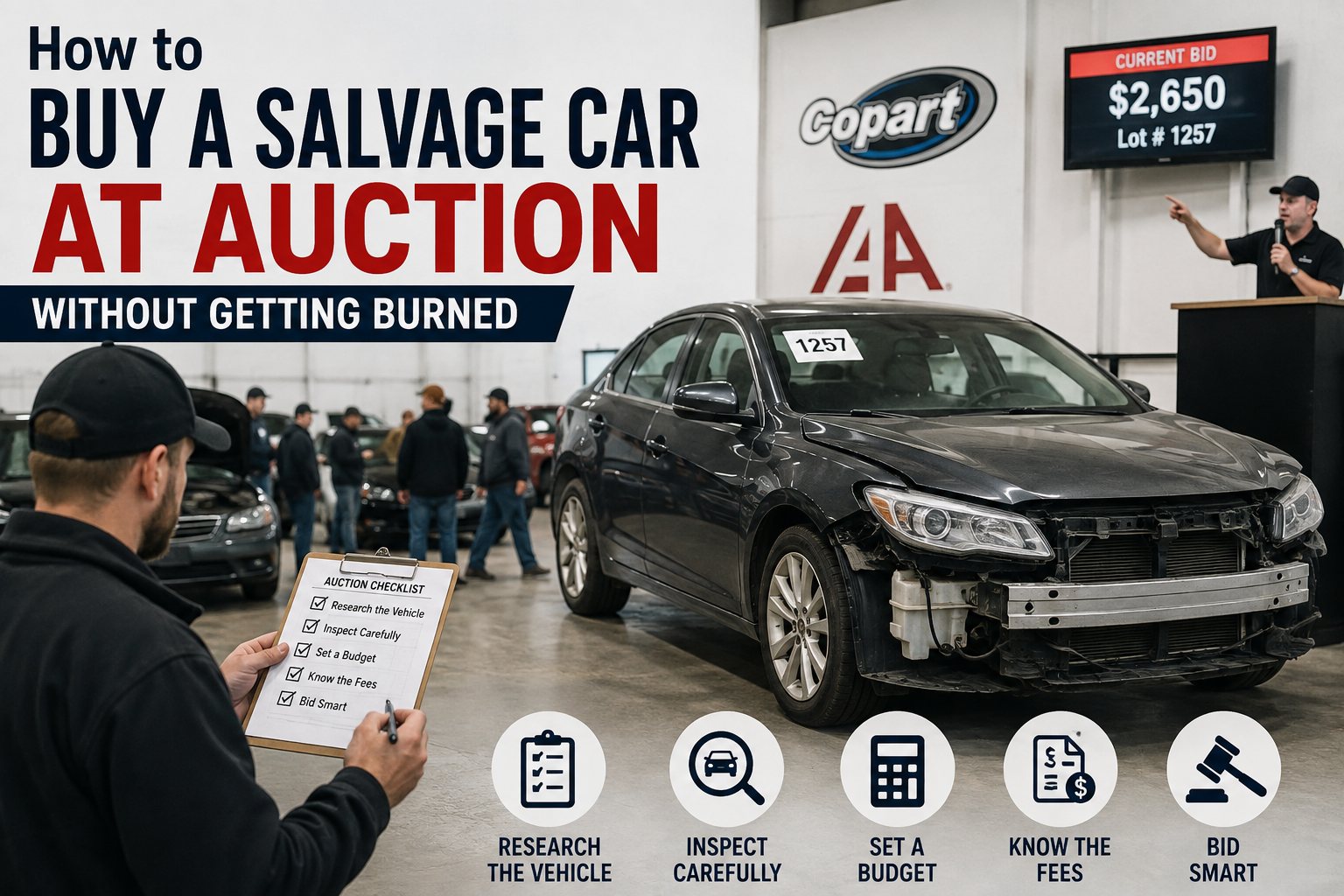
A silver 2022 SUV sits on the Copart lot with a minor dent and a $14,000 estimate. Two days later it sells for $9,200 at a salvage car auction, and the winner still saves thousands after fees. That promise draws first-time buyers to Copart and IAAI every week. The reality is less glamorous: auctions are online-only, photos tell half the story, fees add 20% to 30% on top of your bid, and one careless click costs more than the discount ever promised.
This article walks through how to buy a salvage car at auction in the US step by step: registering on Copart and IAAI, reading listings like a professional, budgeting the real costs, and bidding without emotions. Learn the process before your first bid, and auctions become the cheapest car buying channel in the country. Skip it, and the cheapest channel becomes the most expensive lesson.
Quick Answer
To buy a salvage car at auction, register with Copart or IAAI (or use a licensed broker), research the title type and photos carefully, set a maximum bid that includes the roughly 20% to 30% in auction fees, use pre-bid or proxy bidding instead of emotions, then pay and pick up the vehicle before storage fees start. Inspections before bidding are limited, so beginners should favor run-and-drive vehicles with documented damage and bid conservatively on their first purchases.
How Salvage Car Auctions Like Copart and IAAI Work
Copart and IAAI (Insurance Auto Auctions) process millions of vehicles every year. Most come from insurance companies after total-loss claims, and a smaller share arrives from banks, rental fleets, and dealers. Auctions list each vehicle with photos, a damage report, a title type, and a sale status, then sell to the highest online bidder. There is no test drive, and in most cases no physical inspection, so the listing itself is nearly all you have.
Before bidding, you must understand what you are looking at, because a car with a salvage brand is not legally drivable, and it helps to first learn what salvage means on a vehicle. If that car is later repaired and passes inspection, it becomes rebuilt, and the difference between salvage and rebuilt titles decides what you can legally do with the vehicle after you win it.
| Feature | Copart | IAAI |
|---|---|---|
| Annual vehicles processed | Around 4 million | Around 2.5 million |
| Public buyer membership | Basic $99/year, Premier $249/year | $200/year, inventory varies by state |
| Broker option | Yes, typically $150 to $350 per car | Yes, typically $150 to $350 per car |
| Bidding style | Pre-bid plus live VB3 platform | Pre-bid plus live AuctionNow |
| Best known for | Largest selection, strong international support | Insurance total-loss vehicles |
Step 1: Register With the Auction or a Broker
You cannot walk into a salvage auction and bid; access comes in two ways. Direct registration puts you in control: Copart’s Basic membership costs $99 per year with a default bidding limit near $2,000, while the Premier tier at $249 per year plus a refundable $400 deposit unlocks far higher buying power. IAAI charges public buyers $200 per year, and the vehicles you can bid on vary by state. The second path is a licensed broker, who bids under their dealer license for a flat fee, usually $150 to $350 per car. A broker makes sense if your state restricts public bidding or you only plan to buy once.
Step 2: Budget the Real Cost, Not the Winning Bid
The single biggest mistake at any salvage car auction is budgeting only the bid. Fees stack on top of every winning amount, and on a mid-priced car they commonly exceed $600 before taxes and transport:
| Fee Type | Typical Cost |
|---|---|
| Buyer fee (scales with price) | $200 to $650+ |
| Internet / virtual bid fee | $39 to $110 |
| Gate or service fee | Around $95 |
| Environmental fee | Around $15 |
| Title handling fee | $20 to $95 |
| Storage after deadline | Up to $40+ per day |
A safe rule is to add 20% to 30% over the hammer price, then add transport and sales tax. Every auction platform shows a fee calculator, and the professionals run it before bidding, never after winning.
Step 3: Read the Listing Like an Appraiser
Each listing carries three signals that matter more than the photos. First, the title type: salvage, rebuilt, or clean. Second, the condition code: “run and drive” means the vehicle starts and moves under its own power, while “stationary” or “parts only” tells you it does not. Third, the sale status: “pure sale” or “buy it now” cars can be had without a live bidding war, which suits cautious first-timers.
Study every photo in full screen: the damage area, the airbags, the wheels, and the interior. Check how many photos exist, because thin galleries hide problems. Favor vehicles with documented collision damage over vague descriptions, since a bent fender is easier to price than an unexplained electrical fault. And remember that a smart purchase still depends on the same fundamentals covered in our breakdown of how to inspect salvage cars, because the inspection simply happens through photos and reports instead of in person.
Step 4: Set a Maximum Bid and Stick to It
Winning bidders at Copart and IAAI fall into two groups: those who planned their number and those who got carried away. Use pre-bid (proxy) bidding, where you enter your true maximum and the system bids for you in small increments. Decide your ceiling by taking the clean-title market value, subtracting the repair estimate and the fees from Step 2, and leaving at least a 20% margin for surprises. If the live auction climbs past that number, let it go. Auctions list hundreds of thousands of vehicles, and the next deal always arrives.
Step 5: Pay Fast and Beat the Storage Clock
Winning starts a clock. Payment is typically due within one to three business days, and vehicles must leave the yard within a few days after that, or daily storage fees begin stacking at $40 or more. Arrange transport in advance, because most yards require a licensed carrier for pickup. Missing these deadlines is how a $4,000 win quietly becomes a $4,600 win.
Step 6: Plan the Title, Repair, and Insurance Path
The auction only hands you the paperwork; the plan is your job. A raw salvage car must be repaired, inspected, and retitled before daily driving, so read the pros and cons of rebuilt titles before you bid. Insurance needs planning too: many carriers cover rebuilt cars, and you can usually insure and register one like any other vehicle, but confirm coverage for your exact VIN before you spend repair money.
Common Salvage Auction Traps That Burn Beginners
✕ Traps to Avoid
- Bidding on flood or unknown-damage cars because the photos look clean.
- Forgetting fees, transport, and storage until after the hammer falls.
- Chasing a live auction past your pre-set maximum in the final seconds.
- Skipping the fee calculator because the bid felt cheap.
When Buying at a Salvage Auction Makes Sense
✓ Good Fit If
- You are comfortable buying sight-unseen from photos and reports.
- You have cash ready, including fees, transport, and a repair buffer.
- You target run-and-drive vehicles with documented, minor damage.
- You understand the retitle process in your state before bidding.
- You are honest with yourself about whether you should buy a salvage car at all.
Done right, a salvage car auction delivers vehicles at prices no dealership can match. Done carelessly, it delivers expensive lessons. The buyers who win long term calculate the true cost before bidding and walk away without regret when the numbers stop working. That discipline is also why opinions stay divided on whether salvage vehicles are worth buying, and why the answer always depends on the buyer, not the car.
FAQs
Can anyone buy a salvage car at auction?
Yes, in most states the public can bid through a Copart or IAAI membership or through a licensed broker. Some states restrict which vehicles public buyers can purchase, and certain sales are dealer-only, so check your state’s rules before registering.
How much are fees at Copart and IAAI?
Fees vary with the winning price, but expect a buyer fee from roughly $200 to $650, an internet bid fee, a gate fee near $95, an environmental fee, and title handling charges. Add 20% to 30% on top of your winning bid, then budget separately for transport, sales tax, and storage.
Can you inspect a car before bidding at a salvage auction?
Physical inspections are generally not allowed for public buyers, though some yards permit visits and third-party inspection services can check vehicles for a fee. Most buyers rely on the photo gallery, the damage report, and the condition code, which is why documented damage and run-and-drive listings are safer targets.
What does run and drive mean at Copart and IAAI?
Run and drive means the vehicle started and moved under its own power when the yard verified it. It is not a mechanical guarantee, but it is a meaningful signal. Stationary vehicles may only need a battery, or they may need an engine, so price that uncertainty into your maximum bid.
Is buying from a salvage auction cheaper than a dealer?
Usually yes, because auctions skip dealer margins entirely. A disciplined buyer can land vehicles 30% to 60% below clean-title retail even after fees and transport. The trade-off is risk: no test drives, limited inspections, and repair costs that depend entirely on your judgment of the photos and the paperwork.
What happens after I win a salvage car at auction?
You pay within the stated deadline, arrange transport out of the yard before storage fees start, and receive the title paperwork by mail or through your broker. From there the car is repaired, inspected, and retitled in your state before it can be registered for road use.
Related Post

January 9, 2026
Salvage Car
What Does Salvage Mean on a Vehicle? Eve...

August 28, 2026
Salvage Car


