
August 28, 2026
Salvage Car





Can You Actually Insure a Salvage Title Car in the US?
9 minutes read
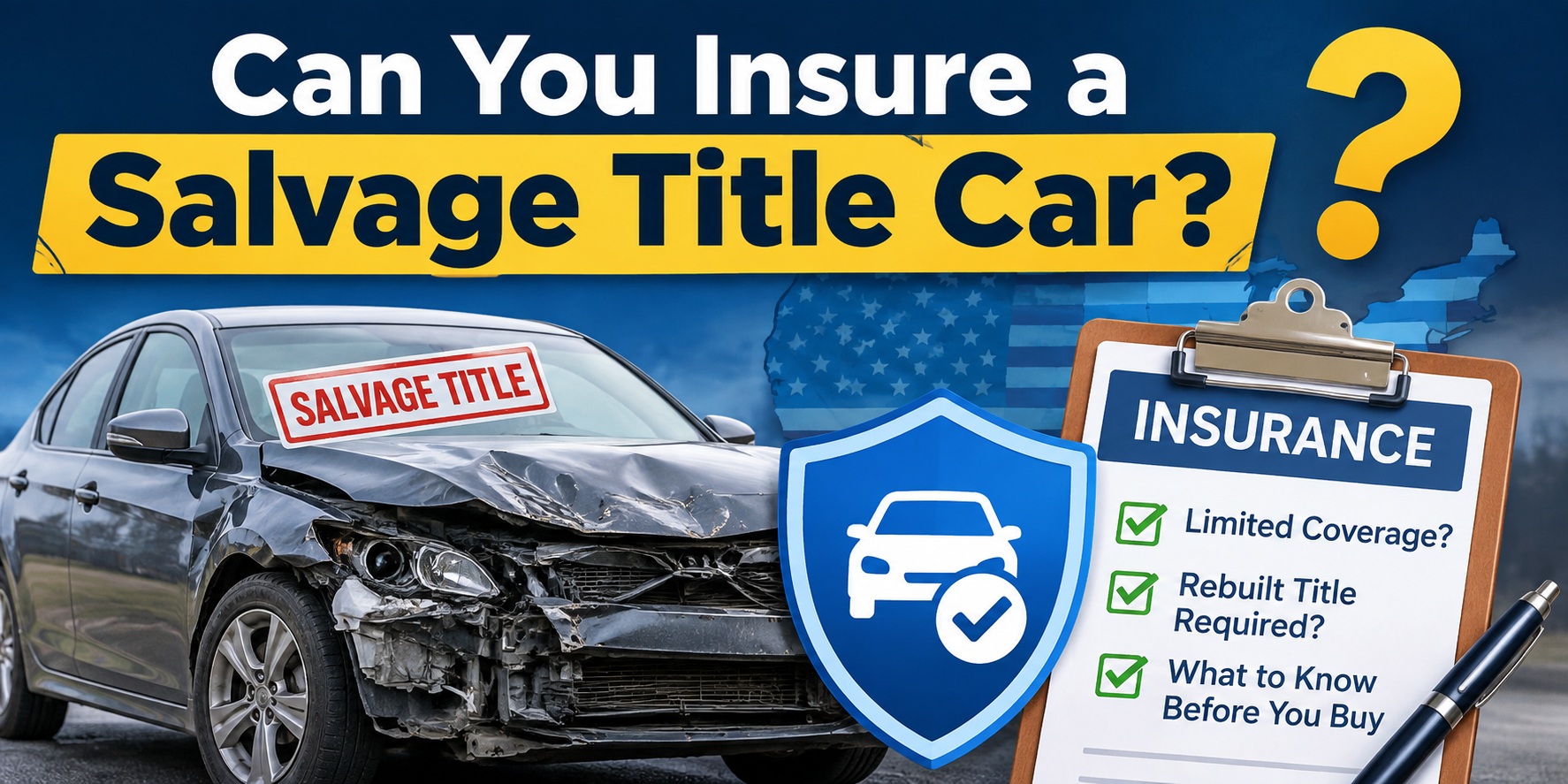
Saw a deal online that looked too good to be true? A truck worth $30,000 listed for $14,000, and the fine print reads “salvage title.” Before you click “buy,” you need to know where you stand with insurance, because a car you cannot insure (or can only partially insure) can quickly turn a bargain into a money pit.
So let’s answer the question head-on: can you insure a salvage title car in the US? The short answer is “not really, but you can insure what it becomes.” Below, we’ll break down exactly what a salvage title means, what kind of coverage you can and cannot get, which insurance companies work with these vehicles, and what it will cost you.
What Is a Salvage Title Car?
A salvage title is a type of vehicle brand issued when a car has been severely damaged and an insurance company declares it a total loss. This typically happens when the estimated repair costs exceed a large percentage of the car’s actual cash value, usually somewhere between 65% and 90%, depending on the state.
Cars can earn a salvage title in several ways:
- Collisions: The most common cause. A serious accident pushes repair costs past the total-loss threshold.
- Flood damage: Hurricanes and flooding can ruin electrical systems, engines, and interiors beyond economical repair.
- Theft recovery: If a stolen car is recovered after the insurer has already paid out a claim, it may be branded salvaged even if it’s barely damaged.
- Hail, fire, or vandalism: Extensive cosmetic or structural damage can also trigger a total-loss declaration.
The critical thing to understand is this: a salvage title car is not street legal. You cannot register it, drive it on public roads, or, in most cases, buy a standard auto insurance policy for it. It exists, legally speaking, as parts or a rebuild project, although a properly repaired one can still be worth buying at the right price.
Salvage Title vs. Rebuilt Title: Why the Difference Matters for Insurance
This is where most buyers get confused, and it’s the single most important concept in this article. The terms are related but not interchangeable:
- Salvage title: The car is damaged and declared a total loss. It cannot be registered, driven, or normally insured.
- Rebuilt title: The salvage car has been repaired to the state’s standards, passed an official inspection (and sometimes a roadworthiness test), and had its title reissued as “rebuilt.” It can now be registered, driven, and insured.
- Clean title: The car has never been declared a total loss.
| Title Type | Legal to Drive? | Liability Insurance? | Full Coverage? |
|---|---|---|---|
| Clean title | Yes | Yes | Yes |
| Rebuilt title | Yes | Usually yes | Sometimes, with limits |
| Salvage title | No | No (except storage-only policies) | No |
| Junk/scrap title | No | No | No |
So when people ask “can you insure a salvage title car,” what they usually mean in practice is: can I insure a car that used to be salvage and now has a rebuilt title? The answer to that question is a qualified yes.
Can You Insure a Car With a Salvage Title? The Straight Answer
If the car still has a salvage title: No
Because a salvage title vehicle is illegal to drive, no reputable insurer will sell you a standard auto policy for it. Insurance is designed for vehicles operated on public roads. There is one niche exception: a few companies offer storage-only or comprehensive-only policies that protect a salvage car against fire, theft, or vandalism while it sits in a garage or shop awaiting repairs. That’s it: no liability, no collision, no driving.
If the car has a rebuilt title: Yes, with conditions
Once the vehicle is repaired, inspected, and retitled, it becomes eligible for insurance like any other registered car, with some important caveats:
- Liability coverage is usually easy to get. Most major insurers will write a liability-only policy for a rebuilt title car. Liability pays for damage you cause to other people, so the car’s own murky history matters far less.
- Full coverage is harder. Collision and comprehensive coverage pay to repair or replace your car, and insurers are naturally nervous about pricing repairs on a vehicle with prior major damage. Some insurers decline full coverage entirely; others require photos, a mechanic’s inspection, or repair documentation.
- Payouts are reduced. Even when full coverage is granted, expect claim payouts based on the rebuilt car’s diminished value, often 20% to 40% below what an identical clean-title car would receive.
- Premiums can be higher. Full coverage on a rebuilt title commonly runs 20% to 40% more than the same coverage on a clean-title equivalent, adding roughly $180 to $480 per year.
Which Insurance Companies Cover Salvage/Rebuilt Title Cars?
Policies vary by state and by the car’s specific history, but these major carriers are known to work with formerly salvaged vehicles:
| Company | Coverage for Rebuilt Title Cars | Notes |
|---|---|---|
| State Farm | Liability + full coverage | Photo/mechanic inspection typically required |
| GEICO | Liability + full coverage | Photos and repair documentation; case-by-case |
| Progressive | Liability; full coverage in many states | Photo inspection may be required |
| Farmers | Liability + full coverage | State-specific restrictions apply |
| Allstate | Liability only in most states | Agent consultation required |
| USAA | Liability + full coverage | Military members and families only |
| Nationwide | Limited, case-by-case | Documentation required |
| The General, Kemper, Infinity, National General | Liability; some full coverage | Often friendly to non-standard situations |
Pro tip: An independent insurance agent is your best friend here. Because they represent multiple carriers, they can quickly identify which companies are writing rebuilt-title policies, including full coverage, in your state. Also note that many insurers won’t give you a rebuilt-title quote online; you’ll often need to call.
How to Insure a Salvage Title Car: Step-by-Step
The full process varies slightly by state, but the core steps look like this:
- Buy and repair the salvage car (or buy one already repaired). If you’re still shopping, have a mechanic inspect it before you pay, and keep every receipt, photo, and parts invoice, because insurers will ask for documentation.
- Apply for a rebuilt title. Each state has its own process, typically requiring a VIN verification, a rebuilt vehicle inspection, proof of ownership, and repair records. The DMV (or a state-approved inspection station) confirms the car is roadworthy and safe.
- Register the car in your name once it passes inspection.
- Gather your paperwork for insurers: the rebuilt title certificate, inspection report, repair receipts, and recent photos of the finished vehicle.
- Get quotes from at least three companies. Start with State Farm and GEICO if you want full coverage; call GEICO or Progressive for quick liability-only quotes.
- Schedule any required inspection. Some insurers send an adjuster or ask for photos before binding full coverage.
- Buy the policy and keep copies of all documents in the car. They’ll matter if you ever file a claim.
How Much Does Salvage Title Car Insurance Cost?
Here’s the honest math. Liability-only insurance on a rebuilt title car usually costs about the same as any comparable car, since the insurer isn’t on the hook for your vehicle’s repairs and its history matters less. Rates depend on your age, driving record, location, and state minimums.
Full coverage is a different story:
- Expect roughly 20% to 40% more in premium than a clean-title car, or about $180 to $480 extra per year.
- Payouts after an accident are typically 20% to 40% lower, reflecting the car’s diminished market value.
- For older rebuilt cars worth $6,000 or less, full coverage often stops making financial sense. Many owners simply carry liability and self-insure the rest.
Should You Buy a Salvage Title Car? Pros and Cons
Pros
- Big upfront savings: Rebuilt cars often sell for 40% to 60% less than clean-title equivalents.
- Slower depreciation: The value has already taken its hit.
- Insurance is available: Liability coverage is straightforward once it’s rebuilt.
Cons
- Limited coverage options: Full coverage is harder to find and pays out less.
- Unknown repair quality: You’re trusting someone else’s workmanship.
- Harder to resell: Many buyers automatically walk away from branded titles.
- Financing challenges: Many banks and credit unions won’t finance rebuilt vehicles, and some states have stricter registration requirements.
Frequently Asked Questions
Can you insure a salvage title car in the US?
Not while it holds a salvage title, because the car isn’t legal to drive, so no standard insurer will cover it. You may find storage-only coverage while it sits in a shop. Once repaired, inspected, and retitled as rebuilt, the car can be registered and insured.
Can you get full coverage on a rebuilt title car?
Yes, but options are limited. Some insurers may offer comprehensive and collision coverage on rebuilt vehicles after an inspection. Availability, eligibility, premiums, and claim valuation can vary by insurer and state.
Is it illegal to drive a salvage title car?
A vehicle with a salvage title generally cannot be legally registered and driven on public roads until it has been properly repaired and meets the applicable state requirements. Registration and inspection rules vary by state.
Will insurance pay out the same amount on a rebuilt title car?
Not necessarily. Insurers may value rebuilt vehicles differently from comparable clean-title cars because of their previous damage history. Coverage and claim valuation depend on the insurer, policy, vehicle, and state.
What’s the cheapest way to insure a rebuilt title car?
Liability-only coverage is often the least expensive option, although the exact cost depends on the driver, vehicle, location, and insurer. If you want protection for the vehicle itself, compare comprehensive and collision options from several insurers.
Does a salvage title void the manufacturer’s warranty?
A salvage designation can affect or void portions of a manufacturer’s original warranty, depending on the manufacturer and the circumstances. Check the specific warranty terms before assuming any original coverage remains.
Related Post
January 9, 2026
Salvage Car
What Is a Salvage Title Car and Are They...

August 17, 2026
Salvage Car


