
August 25, 2026
Salvage Car





Salvage Title Laws by State: A Buyer Reference Guide for the US
18 minutes read
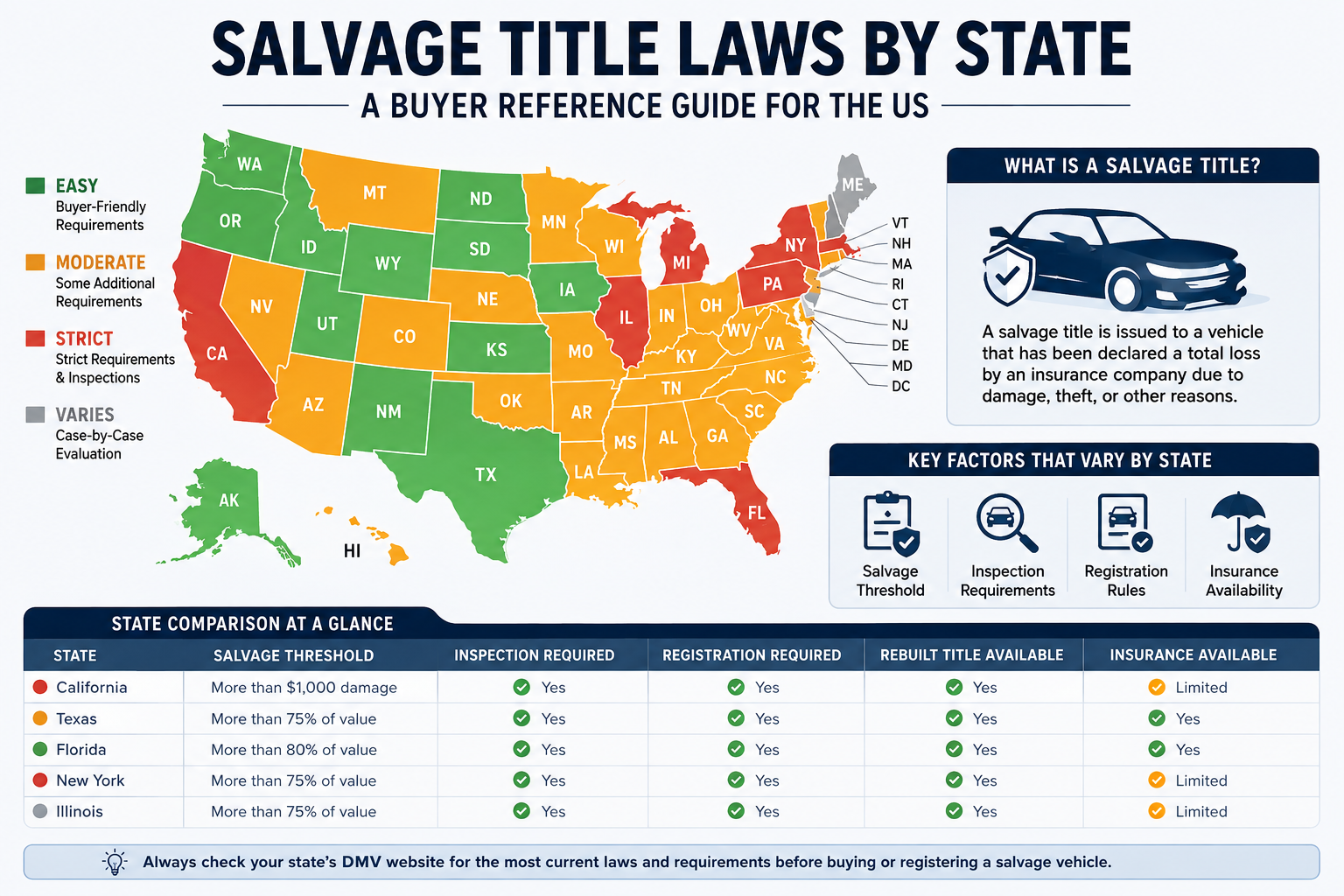
The same repaired truck that takes one appointment and a $40 fee in Florida can need three inspections and months of paperwork in New York, and the difference comes down to salvage title laws by state. A salvage brand follows a vehicle wherever it goes, but the rules for registering, inspecting, and insuring it are written state by state, and they do not always match. Buyers who learn their own state’s requirements before purchasing consistently make better deals than buyers who discover the paperwork afterward.
This guide explains how salvage title laws work across the United States: what a salvage title is, how the salvage title process runs from insurance loss to rebuilt title, how the rules differ across all 50 states, what registration and salvage title inspection requirements look like, how insurance treats branded cars, and what to check before you hand anyone money. It is a practical reference for real buying decisions, not legal advice, and we will flag exactly where you need to confirm details with your own state.
Quick Answer
Every state brands severely damaged vehicles as salvage and requires repairs plus a state inspection before the car can be registered again. What varies is everything around that core idea: the total-loss threshold that triggers the brand, who performs the inspection, what documents you need, what it costs, how long it takes, and how insurers treat the car afterward. Strict states like California, New York, New Jersey, and Massachusetts run demanding multi-step programs, while states like Florida, Texas, Arizona, and Vermont keep the process lighter. Because laws change, always confirm current requirements on your state DMV’s official website before buying or registering a salvage vehicle.
What Is a Salvage Title?
A salvage title is an official brand a state places on a vehicle that an insurance company declared a total loss. In plain language, the insurer looked at the damage, compared the repair bill against the car’s value, and decided fixing it was not worth it. The state then marks the title so every future owner knows the car’s history. A clean title carries no such mark, and that single difference changes everything about the car’s registration, insurability, financing, and price.
Vehicles can earn the brand through collisions, flood exposure, fire, theft recovery, or hail damage, and the problems those cars carry differ wildly depending on the cause, which is worth reading about in our guide to flood damage risks. If the whole world of branded vehicles is new to you, start with what salvage means, then come back here for the legal layer.
How Salvage Titles Work in the United States
The salvage title process follows the same skeleton everywhere, even though the details differ by state:
- Total loss: an adjuster estimates repairs, and when the bill approaches or passes the state’s total-loss threshold (typically somewhere between 65% and 100% of the car’s value), the insurer declares it a total loss.
- Reporting: federal law requires insurers and salvage operators to report the vehicle to the National Motor Vehicle Title Information System, the national database behind most vehicle history checks.
- Salvage title issued: the state brands the title, and the car becomes ineligible for registration or road use.
- Repairs: a rebuilder or owner fixes the car, ideally keeping every receipt and photo.
- Inspection: the state verifies the car is roadworthy and the parts used were legally obtained.
- Rebuilt title issued: the state rebrands the title as rebuilt, revived, reconstructed, or prior salvage, and the car returns to legal road use.
That final brand is permanent, and the journey from total loss to roadworthy is what separates rebuilt from salvage vehicles in everyday use.
Salvage Title vs Rebuilt Title
The two brands describe the same car at different stages, and the salvage title vs rebuilt title distinction is the single most useful thing a buyer can understand:
| Factor | Salvage Title | Rebuilt Title |
|---|---|---|
| Definition | A total-loss vehicle that has not yet been repaired and inspected | A former salvage vehicle repaired and passed through a state process |
| Can it be registered? | No, in every state, except limited salvage-specific permits in some places | Yes, once the state issues the rebuilt brand |
| Inspection required | Not applicable; the brand exists because the car is not roadworthy | Yes, the rebuilt brand is issued only after a state inspection |
| Insurance | Limited to non-driving coverage such as storage policies in some cases | Liability is widely available; comprehensive and collision vary by carrier and state |
| Resale and value | Sells at deep discount to rebuilders and parts buyers | Typically 20% to 40% below comparable clean-title value |
| Buyer consideration | A project purchase that cannot be driven home | A drivable car whose repair history must be verified |
Buying either type is a decision with real trade-offs, and our breakdown of the pros and cons of rebuilt titles covers them in detail.
Salvage Title Laws by State: 25 – State Reference Table
Every state requires an inspection before a salvage vehicle returns to the road, but the authority conducting it, the paperwork demanded, and the fees all vary. The table below summarizes the typical rebuilt-title process and filing fee in 25 key states. Fees change and rules get updated, so treat these numbers as planning figures and confirm on your state DMV’s site before you rely on them.
| State | Typical Inspection Requirement | Typical Filing Fee |
|---|---|---|
| Alabama | State inspection with repair receipts | $50 |
| Arizona | Level III inspection (restored salvage) | $50 |
| California | CHP verification, brake and lamp inspection, smog | $100+ |
| Colorado | Certified VIN inspection with repair receipts | $50 |
| Florida | Light DMV or licensed rebuilder inspection | $40 |
| Georgia | Inspection with damage and repair photos | $100 |
| Illinois | State Police inspection | $95 |
| Louisiana | State police inspection with parts documentation | $60 |
| Maryland | Salvage and safety inspection | $100 |
| Massachusetts | Multi-station reconstructed vehicle inspection | $200+ |
| Michigan | Police inspection, TR-13A form, receipts | $15 |
| Minnesota | State patrol inspection | $20 |
| Missouri | Highway Patrol inspection, notarized receipts | $25 |
| New Jersey | Multi-station MVC inspection | $185 |
| New York | Strict multi-station salvage examination | $150+ |
| North Carolina | License and Theft Bureau inspection | $45 |
| Ohio | Highway Patrol inspection with receipts | $50 |
| Oklahoma | Light inspection; age exemptions apply | $25 |
| Pennsylvania | Enhanced salvage inspection | $135 |
| Tennessee | Anti-theft inspection | $75 |
| Texas | Auto theft detection service inspection | $65 |
| Vermont | Streamlined official inspection and VIN check | $35 |
| Virginia | State police inspection or documentation review | $40 |
| Washington | State Patrol inspection | $50 |
| Wisconsin | Salvage inspection | $50 |
Fee figures are typical filing costs gathered for planning purposes, and several states add separate title, registration, and inspection charges. Verify current amounts with your official state DMV before you rely on them.
States With Strict Salvage Title Requirements
A handful of states run deliberately demanding programs. California stacks a brake and lamp inspection, a Highway Patrol VIN verification, and smog certification, and the sequence can take weeks. New York requires a multi-station examination where the repairs must match the insurance claim file line by line. New Jersey and Massachusetts both require inspections at multiple licensed stations before a rebuilt brand issues, and Pennsylvania applies an enhanced inspection standard. Cars rebuilt under these programs tend to carry the best paperwork in the country, which is worth remembering when you evaluate any used branded car.
States With Simpler Rebuilt Title Processes
Other states keep the path quick and inexpensive. Florida combines a light inspection with a modest fee and huge market demand. Texas runs a straightforward anti-theft inspection through its Auto Theft Detection Service. Arizona, Vermont, and Oklahoma are similarly efficient. Simple does not mean careless, but it does mean branded cars from these states deserve extra scrutiny, because the state asked fewer questions on your behalf.
States With Age Exemptions Worth Knowing
Several states waive parts of the salvage process for older vehicles, which is perfectly legal but explains how some older cars carry clean-looking papers despite serious history. Oklahoma loosens requirements past ten years of age, Arkansas past seven, and North Carolina can issue an unbranded title for older vehicles with an affidavit, while Missouri makes the salvage brand optional past six years. This is exactly why a history report, not the title alone, should drive any purchase decision, and why opinions stay divided on whether salvage vehicles are worth buying.
How to Register a Salvage Title Vehicle
You cannot register a car while it still holds a raw salvage brand in any state. Registration becomes possible only after the vehicle earns its rebuilt brand, and the salvage title registration requirements follow the same general sequence everywhere:
- Obtain the salvage title in your name. Whether you bought the car at auction or from a rebuilder, the branded title must be assigned to you before any state process begins.
- Complete the repairs. Keep itemized receipts for every part and every hour of labor, because most states ask for them and strict states match them against the damage report.
- Gather the paperwork. Typical requirements include the salvage title, repair documentation, a VIN verification form, photo identification, and proof of insurance for the inspection trip where applicable.
- Book the state inspection. Depending on your state, that means the state police, highway patrol, sheriff, DMV, or a licensed inspection station, and appointment backlogs can add weeks.
- Pass the inspection and receive the rebuilt brand. Once approved, the state issues the rebuilt title, and the car becomes eligible for standard registration and license plates.
- Register and insure the car. With the rebuilt title in hand, standard registration applies, and you can line up coverage the same way you would for any used car.
Requirements differ by state because each state writes its own vehicle code and assigns its own inspectors, so the sequence above never changes but the depth of every step does. Where you source the car matters too: public buyers at a salvage car auction receive salvage-branded paperwork that starts this whole sequence, while cars already rebuilt in another state skip it but must satisfy your state’s acceptance rules.
Do Salvage Vehicles Need an Inspection?
Yes, in every state that offers a rebuilt path, an inspection sits between the repairs and the new title. The salvage title inspection requirements exist for three reasons: to confirm the car is structurally and mechanically roadworthy, to verify that the vehicle identification matches its paperwork, and to confirm that major parts were legally obtained rather than stolen. What varies is the depth. A VIN verification can take minutes, while a multi-station examination in New York or Massachusetts can review every major system and every receipt. Whether your state uses police, DMV staff, or certified stations, the inspection fee is almost always small compared with the time the appointment can take, so build that wait into any repair timeline.
Can You Insure a Salvage Title Car?
A car with a raw salvage brand is not registered, so the practical insurance question applies to rebuilt cars, and the answer is generally yes with conditions. Every state requires minimum liability coverage on registered vehicles, and rebuilt cars qualify for it with most insurers. Comprehensive and collision coverage are the variable parts: some carriers offer them on rebuilt vehicles, some require photos or an inspection first, and some decline branded cars altogether, so salvage title insurance requirements end up shaped as much by the insurer as by the state. Claim payouts on branded cars are typically calculated at reduced value, which is why lining up a quote for your exact VIN before purchase matters so much. We cover the carrier landscape and coverage mechanics in our guide to whether you can insure and register a rebuilt car.
Can You Drive a Car With a Salvage Title?
This is where owning, registering, and driving get confused, so here is the clean breakdown:
- Owning: legal anywhere. You can buy, sell, and hold title to a salvage vehicle in every state.
- Driving: not legal on public roads while the car holds a raw salvage brand in any state. A few states issue limited movement permits for inspection trips, but those are the exception, not the rule.
- Registering and driving after rebuild: legal everywhere once the car passes its state process and earns the rebuilt brand.
So when someone asks can I drive a car with a salvage title, the accurate answer is not until it is rebuilt, and buying a salvage car always means budgeting for transport on day one.
How Salvage Titles Affect Car Value
A branded title typically cuts a car’s market value by 20% to 40% compared with its clean-title equivalent, and the discount is permanent. That shape affects buyers in four concrete ways. Resale takes longer because a smaller pool of shoppers considers branded cars. Financing shrinks because many banks decline branded-title loans, pushing purchases toward cash. Insurance payouts shrink with the value even when full coverage is available. On the flip side, the discount is also the entire appeal: buying a properly rebuilt car at 40% off is a genuine strategy, provided the car’s condition justifies the price. The full financial trade-off is laid out in the pros and cons of rebuilt titles.
What to Check Before Buying a Salvage Car
Whether you are evaluating a rebuilt car at a dealer or a raw project online, this checklist covers the ground that matters most:
| Check | What to Look For |
|---|---|
| VIN and title history | Run a paid history report (Carfax or AutoCheck) and confirm every brand the car has carried, using the free NMVTIS-based VINCheck for a quick fraud screen |
| Damage history | What caused the original loss, and how severe was it |
| Insurance records | Settlement photos or claim details showing what the insurer saw |
| Repair documentation | Itemized receipts for parts and labor, matched to the damage |
| Professional inspection | An independent mechanic’s opinion before money changes hands; the fundamentals are covered in how to inspect salvage cars |
| Frame and structural damage | Straight frame rails, even panel gaps, no folded metal in the structure |
| Flood and fire damage | Water lines, silt, musty smell, or fire damage in the wiring |
| Airbags and safety systems | Warning lights at startup, evidence airbags were replaced properly |
| Odometer history | Consistent readings across service records and history reports |
| Parts used for repairs | OEM or quality aftermarket parts, documented in the receipts |
| State inspection requirements | Whether your state will accept the car’s current paperwork or re-inspect it |
| Insurance availability | A real quote for the exact VIN before you commit |
If you are still deciding whether the purchase itself makes sense, the honest framework in our guide to whether you should buy a salvage car will walk you through it, and buyers sourcing directly from Copart should read the step-by-step Copart walkthrough before their first bid.
Common Problems With Salvage Title Cars
None of these problems are guaranteed, but they are the realistic risks of branded vehicles, and each one is manageable when you know to look:
- Uneven repair quality: the car is only as good as the shop that rebuilt it, which is why documentation and inspection outweigh the title badge.
- Electrical gremlins: connectors and modules disturbed during repairs can cause intermittent faults months later.
- Diminished value you cannot recover: the brand follows the car through every future sale.
- Thinner insurance and financing: fewer carriers and fewer lenders, as covered above.
- Hidden history in older units: age exemptions in several states mean some cars carry clean titles despite real damage, so history reports matter even for unbranded cars.
None of this makes branded cars bad purchases. It makes them purchases that reward homework, which is exactly why a resource like this exists.
Final Takeaway
Salvage title laws by state follow one shared skeleton with fifty variations. Every state brands total-loss vehicles, blocks their registration until repairs are proven, and requires an inspection before a rebuilt brand issues. What you must confirm for your own situation is the layer on top: your state’s threshold, its inspection process and backlog, its documentation demands, its fees, and how insurers in your market treat rebuilt cars. Those details are all published on official state DMV sites, and a fifteen-minute check there can protect a five-figure purchase.
If you take one rule from this guide, take this one: the title tells you what happened, the inspection tells you what it means, and the state tells you what it will cost to make it legal. Verify all three before you buy, and a branded vehicle can be the smartest money you ever spend on four wheels.
FAQs
What is a salvage title?
A salvage title is a state-issued brand on a vehicle that an insurance company declared a total loss, usually because repair costs approached or passed the car’s value. A salvaged car cannot be registered or driven on public roads until it is repaired, inspected, and rebranded as rebuilt under its state’s process.
Which states have salvage title laws?
All 50 states and the District of Columbia have salvage title laws. The core rule is the same everywhere: a total-loss vehicle must be branded and cannot return to the road without repairs and an inspection. What differs is the total-loss threshold, the inspection authority, the documentation demanded, the fees, and the name of the rebuilt brand.
Can you register a salvage title car?
Not while it holds a raw salvage brand in any state. Registration becomes possible after the car is repaired, passes its state inspection, and receives a rebuilt or equivalent brand. The steps are similar everywhere, but the paperwork depth and inspection rigor vary a great deal by state.
Can you insure a salvage title vehicle?
A raw salvage car is not registered, so standard road insurance does not apply, though limited storage coverage exists in some cases. Rebuilt cars can be insured in every state, with liability coverage widely available. Comprehensive and collision coverage depend on the carrier, and many insurers require photos or an inspection and pay claims at reduced branded value.
Can a salvage title become a rebuilt title?
Yes, and that is the entire purpose of the system. After the repairs are complete, the owner submits the salvage title, repair documentation, and any required VIN forms, passes the state inspection, and receives a rebuilt or equivalent brand such as revived salvage, reconstructed, or prior salvage. The rebuilt brand is permanent and appears on every future title and history report.
Is it worth buying a salvage title car?
It can be, when the discount is deep enough to pay you for the risk. A well-documented rebuilt car priced 30% to 40% under clean-title value can be a smart buy, especially for owners planning to keep it long term. The purchase stops making sense when repair records are missing, the seller resists inspection, or the discount is too small to cover the hassle.
What is the difference between salvage and rebuilt titles?
A salvage title marks a damaged total-loss vehicle that cannot be legally driven or registered. A rebuilt title marks the same vehicle after it has been repaired, inspected, and certified roadworthy by the state. The salvage car is a project; the rebuilt car is transportation. Both brands are permanent history markers.
Can you drive a salvage title car?
Not on public roads while the car holds a raw salvage brand, in any state. You can own it, transport it on a trailer, and repair it, but daily driving becomes legal only after the car passes its state inspection and earns a rebuilt brand. A few states issue limited permits for inspection-related trips.
Related Post

August 29, 2026
Salvage Car
Rebuilt Title Pros and Cons Every Buyer ...

January 9, 2026
Salvage Car


